
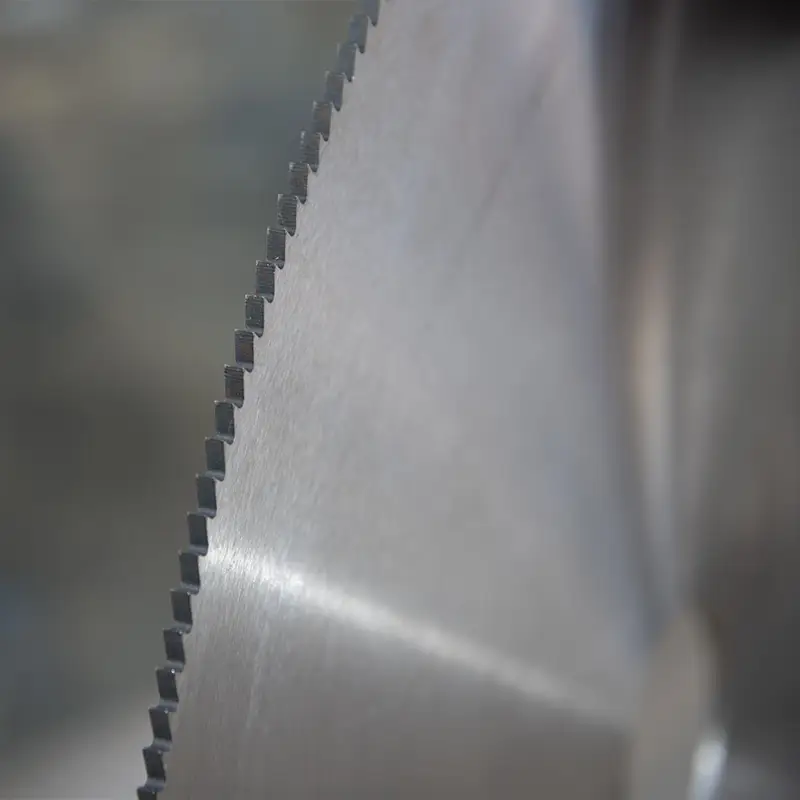
Friction saw blade /hot saw blade
Application: Friction saw blades are used to cut steel of various shapes and thicknesses.
Our friction and hot saw blades are mainly used for cold and hot circular sawing machines and designed for cutting, carbon steel in a variety of sizes and shapes.
5.0
MOQ:
1
Model:
200/ 220/ 240/ 260
Place of Origin:
China
Transaction mode:
T/T
Delivery time:
10 Day
design customization
Please fill out the form below to request a quote or to request more information about us. Please be sure to upload customized requirement documents or pictures, and we will get back to you as soon as possible with a response. we're ready to start working on your new project, contact us now to get started.
Please fill out the form below to request a quote or to request more information about us. please be as detailed as possible in your message, and we will get back to you as soon as possible with a response. we're ready to start working on your new project, contact us now to get started.
Product Overview
High quality cutting, the choice of efficiency. As a mature product of the company, it can ensure excellent performance and stable cutting effect under the strictest cutting conditions. Our friction and hot saw blades are mainly used for cold and hot circular sawing machines and designed for cutting, carbon steel in a variety of sizes and shapes.
They are used in flying or stationary sawing machines for tube production lines or for cutting grating and other profiles. During the cutting process, the friction between the saw blade and the material generates high temperatures, which help soften the material and make it easier to cut. Optimized for an extra long blade life and no cracking diameters are available up to 100"(2500mm).
Your Benefits
● Without burr in surface
● Long tool life
● Stable cutting
● Long tool life
● Stable cutting
Customization
● Customized size/ teeth
● Customized logo
● Customized packaging
● Customized logo
● Customized packaging
Common Tooth Profile
直背齿 (5)
三角齿 (5)
曲背齿 (5)
尖背齿 (5)
Friction Saw BladesCommon Specifications
| Ordinal | Diameter | Kerf | Bore | Teeth Number | Class |
| 1 | 12"300 | 2.5/3.0 | 32/40 | Follow your demand | Cold cutting |
| 2 | 14"350 | 2.5/3.0/4.0 | 32/40 | Follow your demand | Cold cutting |
| 3 | 16"400 | 3.0/3.5/4.0 | 32/40 | Follow your demand | Cold cutting |
| 4 | 18"450 | 3.0/3.5/4.0/4.5 | 32/40 | Follow your demand | Cold cutting |
| 5 | 20"500 | 3.5/4.0/4.5 | 70/80 | Follow your demand | Cold cutting |
| 6 | 22"550 | 3.5/4.0/4.5/5.0 | 70/80 | Follow your demand | Cold cutting |
| 7 | 24"600 | 3.5/4.0/5.0 | 80/90 | Follow your demand | Cold cutting |
| 8 | 26"650 | 4.0/5.0 | 80/90 | Follow your demand | Cold cutting |
| 9 | 28"700 | 4.0/5.0 | 90/100 | Follow your demand | Cold cutting |
| 10 | 32"800 | 5.0/6.0/8.0 | 70/110 | Follow your demand | Cold cutting |
| 11 | 40"1000 | 7 | 120/140 | Follow your demand | Cold cutting |
| 12 | 44"1100 | 7.5/8.0 | 120/125 | Follow your demand | Cold cutting |
| 13 | 48"1200 | 7.5/8.0 | 125/130 | Follow your demand | Cold cutting |
| 14 | 56"1400 | 7.5/8.0/9.0 | 180 | Follow your demand | Cold cutting |
| 15 | 60"1500 | 9 | 180 | Follow your demand | Cold cutting |
| 16 | 64"1600 | 9.0/10.0 | 180 | Follow your demand | Cold cutting |
| 17 | 32"800 | 5 | 110 | Follow your demand | Hot cutting |
| 18 | 33"820 | 4.0/5.0 | 110 | Follow your demand | Hot cutting |
| 19 | 36"900 | 5.0/6.0 | 110/300 | Follow your demand | Hot cutting |
| 20 | 40"1000 | 5.0/6.0/7.0 | 160/300 | Follow your demand | Hot cutting |
| 21 | 44"1100 | 6 | 300 | Follow your demand | Hot cutting |
| 22 | 48"1200 | 6.0/7.0/8.0 | 160/300 | Follow your demand | Hot cutting |
| 23 | 52"1300 | 6 | 340/360 | Follow your demand | Hot cutting |
| 24 | 60"1500 | 7.0/8.0 | 300/360 | Follow your demand | Hot cutting |
| 25 | 64"1600 | 7.0/8.0/9.0 | 300/480 | Follow your demand | Hot cutting |
| 26 | 66"1650 | 9.0/10.0 | 400/500 | Follow your demand | Hot cutting |
| 27 | 68"1700 | 9.0/10.0 | 320 | Follow your demand | Hot cutting |
| 28 | 72"1800 | 9.0/10.0 | 400/550 | Follow your demand | Hot cutting |
| 29 | 80"2000 | 10.0/12.0 | 500 | Follow your demand | Hot cutting |
| 30 | 84"2100 | 13.0/14.0 | 500 | Follow your demand | Hot cutting |
| 31 | 88"2200 | 14 | 400 | Follow your demand | Hot cutting |
| 32 | 100"2500 | 15 | 500 | Follow your demand | Hot cutting |
| Please feel free to contact us for any special requests | |||||
application
A06 (3)
A05 (3)
A04 (3)
BB01
B03
B02
Notes

{{item.score}} Stars
{{item.pre}}%
{{item.nickname ? (item.nickname.slice(0, 2) + '*****') : item.source === 1 ? 'mall buyer' : '--'}}
{{item.comment_time}}
Review in the {{item.country}}
{{itemAttr.params_key}}: {{itemAttr.params_value}}
Speak with a trusted advisor
If you are looking for sawing tools and reliable solutions, please feel free to contact ELEFANTE TOOLS.
Related Products
no data
no data
Quick links
Products
Copyright © 2026 ELEFANTE TOOLS | Sitemap